AjayShah

  • Subscribe to our RSS feed.
  • Twitter
  • StumbleUpon
  • Reddit
  • Facebook
  • Digg

Thursday, 28 October 2010

An option chain for INR/USD

Posted on 20:43 by Unknown
We are all used to seeing the options chain for Nifty, but now you have one for INR/USD.


Also read Mobis Philipose in Mint on the unfinished business of derivatives trading in India.
Read More
Posted in derivatives | No comments

Who will make the exchange-traded currency options market?

Posted on 20:17 by Unknown
In a few minutes, NSE and USE will start trading in currency options. This will be the first exchange-traded options in India on a non-equity underlying.


Currency options are obviously useful as a risk-management tool. I feel that futures are nice simple linear contracts: they ask the person to make only one decision -- are you long or are you short. But once a futures position is entered into, the person needs the ability to manage the position since daily marking-to-market is done, and since there can be large losses for either the futures long or the futures short.


Compared with this, long positions on call or put options appeal to the kind of person that is willing to think carefully about a position at the outset, but after that it is fire and forget. This better describes the life of many firms exposed to currency risk, particularly those with relatively weak treasuries.


Currency options have, of course, been traded OTC for some time now. But there are real problems with this market. Customers have sometimes been ripped off by banks on pricing, given the lack of a liquid and transparent comparison point. While currency options are offered by banks to customers, there is not much by way of an inter-bank market.


As far as I know, there is relatively little by way of a build-up of human and systems capability in the banks for currency options trading (whether OTC or on exchange).


In contrast, there is a remarkable build-up of human and systems capability in the world of Nifty options trading. Options on Nifty have shaped up as one of the biggest options markets in the world. This involves end-users who think and trade options, staff working for securities firms who understand options (and understand issues about their credit risk when their customer has an options position), analytical software systems, and (most importantly) algorithmic trading systems. Options trading inevitably involves trading in a large number of underlyings. Strong computer systems which are able to think about, and place orders in, all the underlyings at one shot are of essence in achieving option liquidity. Such capabilities are now found in the world of Nifty options, and are absent in banks or in the OTC currency options market.


It is fairly easy for a person trading Nifty options to move to trading currency options. Hence, the brainpower and systems that have made Nifty options one of the world's top contracts will easily be able to move to currency options trading, and make it work. I expect that the securities firms who dominate Nifty options trading will now dominate currency options trading.


I think three kinds of stories will now kick in:


  1. Liquidity in currency options will fuel liquidity in currency futures, and vice versa. Corporate hedgers will be more interested in either, given that the other is also a possibility.

  2. Skills and systems from Nifty options will flow into currency options. Banks will be able to rapidly bulk up their options capabilities by recruiting from the world of Nifty options, and by purchasing the software systems that have sprung up in that space.

  3. Conversely, trading in both currency options and Nifty options will generate an increased business size for people who build knowledge and systems for options; it will also improve knowledge of options trading through an understanding and comparison of the nuances of two different underlyings. The number of FRM and PRM certified people in India will go up.

Also see.


Of great interest will be the question of currency volatility. On one hand, the currency options market will generate an implied volatility for the currency, which will represent a market-based forecast for what future currency vol will be. This will be a big new piece of information which will inform macro policy and monetary policy, and thus diminish the extent to which we are flying blind in thinking about Indian macroeconomics.


In recent years, RBI has mostly stayed off from trading the currency market, so the volatility of the INR/USD is a true market volatility. If, in the future, RBI thinks that it wants to give subsidised currency risk management services to the private sector, one way in which it would be able to do that is to do `intervention' on the currency options market so as to force down the implied vol of the market. I.e., RBI would sell ATM calls and ATM puts and thus drive down that price, and thus give cheaper risk management services to the market. This would represent the first operational intervention strategy for RBI through which it can pursue the goal of reducing volatility without distorting the INR/USD exchange rate.


If RBI gets into actively trading the currency market again and trying to push the rupee into a de facto pegged exchange rate, we will see this clearly in the currency options market as a sharply reduced implied vol.
Read More
Posted in currency regime, derivatives, finance (innovation), financial firms, financial market liquidity, information technology | No comments

Monday, 25 October 2010

Better living through economics

Posted on 18:15 by Unknown

The `lemons model' in milk procurement


One of the classic stories of India of old is that of Amul, which brought new technology into milk procurement. When the farmer brought his shipment of milk to the Amul front-end, a centrifuge was used to measure the characteristics of this shipment, and based on this payments were made. See this blog post by Alok Parekh, Naman Pugalia and Mihir Sheth. This eliminated the incentives for aduleration of milk by the farmer, which used to be done by adding in water or by skimming the cream.


We can think about this differently. Suppose the centrifuge was not there at the front end. Then the buyer of the milk faced asymmetric information about the characteristics of the milk that were being offered to him. Generally we expect that faced with this `lemons' problem, the buyer would bid low prices for the milk.


So to some extent, the ability of Amul to pay higher prices for milk is not about the greatness of cooperatives when compared with profit-oriented firms: it was about the injection of new technology which removed this asymmetric information.


The interesting puzzle is: in that age, why was Amul the pioneer in buying centrifuges? Why did no private firm buy centrifuges and create a winning business model around milk?


Penalty structure under incomplete detection


Another nice idea that we have understood is the relationship between the probability of getting caught and the penalty. Suppose the fee required for parking is Rs.10 and suppose the probability of getting caught when illegally parked (i.e. without paying the fee) is 10%. Then it's sensible to set the penalty for getting caught at Rs.100 so that even a risk-neutral person will prefer to play by the rules.


This can be applied in the problem of milk procurement. Suppose we say to the farmer: We'll trust you and accept your milk, but on a sampling basis, one in ten farmers will be tested.


Suppose a person added 2 litres of water to his shipment of milk and suppose the price of milk was Rs.10 a litre. In that case, he was trying to steal Rs.20 by palming off low quality milk. But there was only a 10% probability of getting caught, because only one in ten farmers is tested. So the penalty he should face should be Rs.200. If this is done, the risk-neutral farmer is agnostic between playing fair and cheating, even if only one in ten farmers is tested.


The advantage of this strategy is that for 90% of the farmers, the deadweight cost of putting a sample into the centrifuge is eliminated.


This idea is, of course, general:

  • Sometimes, we are in situations (as in market manipulation in finance) where we know that even the best regulator in the world will only catch some of the crooks. So we should estimate what fraction of the crooks are getting caught, and then multiply up the size of theft that was attempted. That is, the right way to think of disgorgement is not that the bad guys should fork up the money that was stolen, but that the penalty imposed by the government should be equal to the size of theft divided by the probability of detection.


  • Sometimes, while comprehensive checking is feasible, it's quite expensive, and it's efficient to deliberately only do checking on a sampling basis. A fairly modest scale of randomised checking (e.g. 5%) can do the trick, coupled with a 20x multiplication factor against the size of the theft that was attempted. This would yield a 95% reduction in the amount of checking that is required. This is the idea in the milk example above.

Read More
Posted in incentives, legal system, securities regulation | No comments

A cross-country comparison of charges of exchanges

Posted on 15:17 by Unknown
In reading this article in the Wall Street Journal by By Rebecca Thurlow, Alison Tudor And P. R. Venkat about the potential merger of SGX with ASX, I saw this interesting cross-country comparison of exchange charges (in basis points):


Country Trading and clearing Taxes
Singapore4.750
Hong Kong1.120
Taiwan0.7530
Korea0.5430
Australia0.530
India0.3527
Japan0.240


It is quite a striking set of facts.


First, we see that in terms of the core trading and clearing -- the charges of the exchange -- India is the 2nd lowest in this pile, with a value of 0.35 basis points. This is slightly worse than Japan (0.24 basis points) and superior to all the others. This partly derives from the immense economies of scale at NSE and BSE, which are ranked at 3 and 5 in the world by number of transactions. This is also about the cost-efficiency of the human part of running an exchange: small exchanges like SGX cannot match the price points which NSE and BSE can reach. In this field, as in finance more broadly, India is pretty good at reaching up to world class at below the world price. This was the basic logic, if you recall, of Percy Mistry's Mumbai as an International Financial Centre report.


Secondly, we see the huge problem that transactions taxes present in all these countries other than Singapore, Australia and Japan. The Indian charge of 0.35 basis points is just swamped by the taxation of 27 basis points. Even if NSE cut charges by half, and got down to 0.175 basis points, this would do nothing for the end-customer who is paying 27.35 today and ends up paying 27.175 across the price cut. Conversely, Singapore, with the least efficient exchange (4.75 basis points) ends up being a nice place for the customer because there is no tax upon transactions there: only Australia and Japan are better than Singapore.


Economists are very clear that all taxation of transactions is distortionary. It's puzzling why so many countries (four out of these seven) continue to indulge in something which is an elementary mistake in public policy.
Read More
Posted in Bombay, financial market liquidity, international financial centre, publicfinance (tax) | No comments

Wednesday, 13 October 2010

Currency conflicts come to prominence again

Posted on 10:54 by Unknown
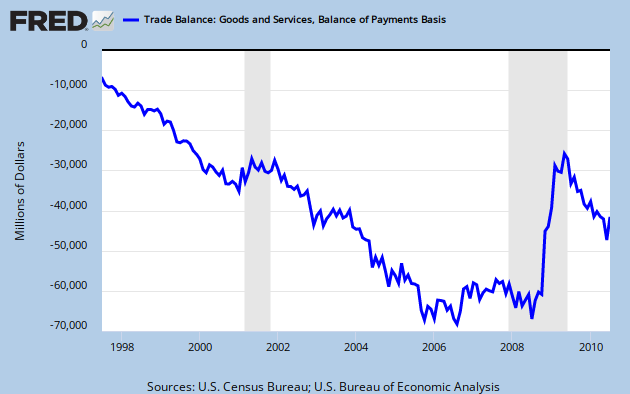
From the mid 1990s onwards, the US trade balance has steadily become bigger. This is a centrepiece of the problem of `global imbalances'. Starting from values of roughly zero, this got all the way to values like $70 billion a month, where the US was importing over $2 billion a day of capital to pay for the trade deficit. Here's the picture:


The US trade balance (goods+services, per month, seasonally adjusted)
This was termed as the `Bretton Woods II' configuration, where exporting countries like China gave loans to the US, in a form of suppliers' credit, and the US bought Chinese goods. This magnitude of capital import was un-sustainable for the US. Something had to give.


Warning for Indian readers: In India, the term `trade balance' pertains only to merchandise trade. In the US, the monthly trade data covers both goods and services. So it is a meaningful measure of what is going on in international trade, unlike the corresponding Indian data.


Bretton Woods II first broke down in the financial crisis. In the downturn, the mighty American consumer purchased fewer 50" television sets. The US trade deficit dropped nicely all the way to $25 billion per month. Alongside a rise in the US savings rate, this looked like a world which was rebalancing.


In recent months, this movement reversed itself and the US trade deficit once again started getting worse.   A deterioration of $20 billion per month is visible; i.e. a deterioration of $240 billion a year. Suddenly, the story of global imbalances righting themselves came under question. The present US run rate is around $40 billion a month or $0.5 trillion a year.


Alongside this, we have news that the Chinese reserves rose by $194 billion in Q3 2010. The Chinese seem to have also passed on some of their problems of exchange rate pegging upon their neighbours by purchasing Japanese, South Korean and Indonesian assets. I am not aware of such behaviour having been observed prior to this in human history. Japan, South Korea and Indonesia have taken unkindly to this behaviour. Given the opacity of the Chinese regime, one can't help wonder if similar things are going on through less visible channels - e.g. a Chinese sovereign wealth fund buys $10 billion of OTC derivatives on Nifty.


So we seem to be headed for quite some escalation of conflict over the Chinese exchange rate regime. Here are some interesting readings on the subject:
  • What happens if the RMB is forced to revalue? by Michael Pettis on his blog.

  • Why America is going to win the global currency battle, by Martin Wolf in the Financial Times.

  • The final end of Bretton Woods 2? on Tim Duy's Fed Watch (the source of the above graph).

  • The effect of RMB appreciation on the US-China trade balance, by William Thorbecke on voxEU.

  • An interview with Raghuram Rajan on der Spiegel.

  • Evolution of the exchange rate regime in Asia.

  • How to avoid trade war: A reciprocity requirement, by Daniel Gros on voxEU, which makes a lot of sense to me as one of the least troublesome policy avenues to go down.

Read More
Posted in capital controls, China, currency regime, global macro | No comments

Tuesday, 12 October 2010

Movement on FSDC

Posted on 12:53 by Unknown


MoF press
release
on FSDC.


For the background on FSDC, see: the budget
announcement
of Feb
2010, a
newspaper column of mine
on 16 March,
and a
collection of responses in the media
on 20 March.


Does the FSDC amount to clipping RBI's wings?

The FSDC is only a committee. It is not backed by law. So nothing
changes about RBI's role and function.


RBI staff have done speeches saying that financial stability is
their job.

The RBI Act does not contain the word `financial stability'. So
while some in RBI might aspire to such a function, the present role
and function of the RBI does not include financial stability.


The FSDC is not a new law, it's merely a committee, so what
changes? We already had the HLCC. What changes with the FSDC?

The FSDC is intended to have a full-time technical
secretariat which will work on the problems of financial stability
and development. This is something the HLCC lacked. And, the HLCC
was chaired by the RBI Governor. He was unable to resolve three
classes of situations: (a) Differences between two financial
agencies such as the ULIPs question, (b) Differences between two
financial agencies when one of them was RBI and (c) Problems of
financial stability which require system thinking, which no one
Indian agency is good at understanding, given the silo system that
is in place. The FSDC should fare better on all three fronts by
virtue of being chaired by the finance minister (and backed by a
strong secretariat).


So will the FSDC help matters?

It all depends on the staff quality that DEA is able to put into
it. The "strong secretariat" is only an aspiration at the present
moment.


What is the right role for autonomy for an agency external to
MoF?
There are href="http://www.mayin.org/ajayshah/MEDIA/2010/autonomy.html">two
clear areas where autonomy is required. The first is about
specific transactions. As examples, what entities get bank licenses or
exchange licenses? Or, when RBI/SEBI investigate Bank of Rajasthan or
MCX-SX. It is highly desirable for MoF to be completely hands-off on
these kinds of activities of agencies external to MoF. The second is
about monetary policy, i.e. the setting of the short-term interest
rate. For these two areas, there is a strong and clear case for
de-politicisation and autonomy. In other questions, the case for
autonomy is not clear-cut.


So is it okay for MoF to meddle in the decisions of an external
financial agency on subjects like the policy framework for
exchange ownership, or the rules about private bank entry?

The staff quality that DEA is able to put into these functions
is supremely important. It is possible to do this right.


Is FSDC opening a Pandora's box by asking too much of DEA staff quality?

I think it is an attempt in the right direction. Largely speaking,
it is converting the existing de facto arrangements
into de jure with greater formal structure. If FSDC builds up
top quality staff, then it will make progress. Else, it will be
irrelevant and the present will continue mostly unchanged.

There will of course be ups and downs, but when I look back at the
brainpower at DEA from 1993 onwards
I feel optimistic about the expected value of FSDC.

The attempt at
building a team which works on financial stability and development
is an important and a good one. Success on putting together a top
quality team cannot be taken for granted. But at the same time, if
MoF had not tried this, there would have been a certainty that such
a team would not have come together. It is possible to spin this in
a gloomy way, but an oversupply of cynicism can crowd out attempts at
progress.


Read More
Posted in announcements, financial sector policy, policy process | No comments

Sunday, 10 October 2010

Interesting readings

Posted on 22:01 by Unknown
C. J. Chivers has a story in the New York Times from Uzbekistan which links up to an idea that I have often thought would be a great step forward for India: the interior of every police station in the country should be blanketed with video cameras giving feeds out to the Net. As Robert Kaplan says, underdevelopment is where the police are more dangerous than the criminals. If we think surveillance cameras are important in public places, they are triply important to watch the interiors of police stations. On a related note, see this harrowing story about a journalist in Pakistan. Do we do similarly?


A fascinating fact about insurgencies: while a diverse array of weapons can be in fray, ammunition is quite well standardised. Writing about the guns used by the Taliban, C. J. Chivers points out on the New York Times blog, `for the 24 rifles and machine guns in the locker, produced in multiple nations over many decades, only three types of cartridges are required to feed them'.


Shobhana Subramanian in the Financial Express on C. B. Bhave. And, Sandeep Singh has a story in the Hindustan Times about Mr. Bhave coming through fine on one attack on him.


Ashok Desai reviews a book in Business World. Also see.


Auditor and Audit Committee Independence in India by Jayati Sarkar and Subrata Sarkar.


Developments on MCX:

    - John J. Lothian is a respected observer of the global securities business. He has written a piece about Financial Technologies Group titled You gotta earn it.

    - Mobis Philipose in Mint.

    - Deepshikha Sikarwar in the Economic Times.

    - A story by Deepika D. Thapliyal on NDTV.


An editorial in Business World on the MoF Working Group on Foreign Investment.


Learn R in Bombay.


Gautam Bhardwaj in the Indian Express on using the NPS to solve the problems of EPFO.


Sunil Jain on the difficulties of the data reported by the Indian statistical system.


An editorial in the Business Standard about developments on private container train companies, which reminds me of the conflicts between DoT and private telecom companies in the early 1990s.


Mobis Philipose worries about the apparent turnover numbers that we're seeing.


An editorial in the Mint on the latest attempt to keep FMC separate from mainstream financial regulation.


Jan Sjunnesson Rao in Education World on the damage that the Right to Education Act is causing.


The Economics of Foodgrain Management in India by Kaushik Basu, DEA Working Paper, September 2010.


A recent paper by Guido Heineck and Bernd Sussmuth finds that the blight of communism runs deep: Using data from the German Socio-Economic Panel, we find that despite twenty years of reunification East Germans are still characterized by a persistent level of social distrust. In comparison to West Germans, they are also less inclined to see others as fair or helpful..


A great interview with Condoleezza Rice on Spiegel Online about the halcyon days of 1989.


The last practical connection with World War I just died away. The legacy of that war, of course, remains with us; everything that came after was attenuated.


David Sanger in the New York Times; Jaswant Singh and Jeffrey N. Wasserstrom on Project Syndicate, on Engaging China. Also see these threats being made against Norway.


Mick Meenan in the New York Times about kabbadi going places.


A great story about the innovative logistics of the Italian army in Ethiopia in 1938.


Greg Mankiw on the high marginal tax rates which are hobbling labour supply in many countries.


China's Charter 08 is a brilliant and well-crafted document, worthy of a Nobel Peace Prize.


Norman MacLean wrote a great article in Lapham's Quarterly about his 1928 experiences with violinist, watercolorist, chess player, and physicist: Albert Michelson. They don't make men like that these days.


Randall Stross in the New York Times on the making of Steve Jobs.


Brad DeLong on Who can replace Larry Summers?.


A great article by Michael Heilemann on binarybonsai: George Lucas Stole Chewbacca, But It's Okay, which made me think about how copyright, patents and `intellectual property' fit uneasily into the creative process. As he says: Chewbacca didn't spring to life out of nowhere, fully formed when Lucas saw his dog in the passenger seat of his car. That's the soundbite. A single step. The reality is complex and human. From vague names floating around, the kernel of an idea, changing purposes and roles of characters, major restructuring, the design hopping from person to person, scrapping the existing concept and going down a different path, seeing existing things in a different light and having to conform a range of ideas to complement and enrich one another.. Everything is a remix.


At the frontiers of computing is `cloud computing', where users rent equipment, e.g. by the hour. Amazon's tariff card for such rental is bad news for developers who built knowledge on Microsoft technologies.


John Taylor has a story about Japanese currency manipulation. Recent research shows that the role of the Yen in global currency arrangements has been waning, and this episode of currency trading by the BoJ will exacerbate this trend.
Read More
Posted in | No comments
Newer Posts Older Posts Home
Subscribe to: Posts (Atom)

Popular Posts

  • Getting to a liberal trade regime
    I wrote two columns on trade liberalisation in Financial Express : Where did the Bombay Club go wrong? Trade liberalisati...
  • 11th Conference of the Macro/Finance Group
    All the materials are up on the website.
  • The disaster at Maruti
    The news from Maruti is disgusting . I have been curiously watching  how the stock market takes it in : That Maruti has serious labour prob...
  • A season for bad ideas
    One feature of each period of turbulence is that we get an upsurge of out of the box thinking. While it is always good to think out of the b...
  • Economic freedom in the states of India
    This blog post is joint work with Mana Shah. What is economic freedom? An index of economic freedom should measure the extent to which right...
  • An upsurge in inflation?
    There is a lot of concern about inflation. Most of it is based on perusing the following numbers of the year-on-year changes in price inde...
  • The two escape routes away from domestic formal-sector finance
    Three problems afflict formal-sector finance in India today: capital controls, taxation, and financial policy. The most important financial ...
  • Comments to discuss
    Maps vs. map data: appropriately drawing the lines between public and private Comment by Anonymous: OSM is a good effort, but it's ...
  • The glacial pace of change: QFI edition
    In the Percy Mistry report , there are some striking examples of the inability of the Indian policy process to deliver change at a reasonabl...
  • A sea change in the knowledge of the young in India
    In 1887, roughly 14 million children were born in India, and we got one Ramanujan. It seems reasonable to think that there were 9 others who...

Categories

  • announcements (53)
  • author: Harsh Vardhan (5)
  • author: Jeetendra (3)
  • author: Percy Mistry (3)
  • author: Pratik Datta (6)
  • author: Shubho Roy (12)
  • author: Suyash Rai (6)
  • author: Viral Shah (7)
  • banking (26)
  • Bombay (15)
  • bond market (11)
  • business cycle (20)
  • capital controls (39)
  • China (21)
  • commodity futures (3)
  • competition (20)
  • consumer protection (3)
  • credit market (10)
  • currency regime (45)
  • democracy (37)
  • derivatives (31)
  • education (8)
  • education (elementary) (11)
  • education (higher) (10)
  • empirical finance (4)
  • energy (6)
  • entrepreneurship (9)
  • environment (1)
  • equity (15)
  • ethics (23)
  • farmer suicide (1)
  • finance (innovation) (11)
  • financial firms (23)
  • financial market liquidity (25)
  • financial sector policy (90)
  • GDP growth (37)
  • geography (3)
  • global macro (19)
  • global warming (1)
  • health policy (1)
  • hedge funds (1)
  • history (19)
  • IMF (2)
  • incentives (9)
  • inflation (33)
  • informal sector (14)
  • information technology (34)
  • infrastructure (14)
  • international financial centre (18)
  • international relations (8)
  • labour market (17)
  • legal system (67)
  • market failure (1)
  • media (6)
  • migration (6)
  • monetary policy (46)
  • mores (5)
  • national security (1)
  • offtopic (2)
  • outbound FDI (3)
  • payments (9)
  • pension reforms (8)
  • police (3)
  • policy process (64)
  • politics (12)
  • privatisation (7)
  • prudential regulation (1)
  • PSU banks (7)
  • public administration (6)
  • public goods (26)
  • publicfinance (expenditure) (19)
  • publicfinance (tax (GST)) (9)
  • publicfinance (tax) (14)
  • publicfinance.deficit (8)
  • publicfinance.expenditure.transfers (10)
  • real estate (5)
  • redistribution (10)
  • regulatory governance (2)
  • reserves (3)
  • resolution (2)
  • risk management (3)
  • securities regulation (25)
  • socialism (33)
  • statistical system (31)
  • success (5)
  • systemic risk (3)
  • telecom (12)
  • the firm (22)
  • trade (21)
  • urban reforms (9)
  • volatility (3)
  • World Bank (4)
  • world of ideas (16)

Blog Archive

  • ▼  2013 (81)
    • ▼  September (6)
      • 11th Conference of the Macro/Finance Group
      • Implications of bringing commodity futures into th...
      • Interesting readings
      • Raghuram Rajan's day 1 statement
      • Implications of the Pensions Act
      • A season for bad ideas
    • ►  August (12)
    • ►  July (10)
    • ►  June (18)
    • ►  May (7)
    • ►  April (13)
    • ►  March (6)
    • ►  February (3)
    • ►  January (6)
  • ►  2012 (102)
    • ►  December (7)
    • ►  November (10)
    • ►  October (11)
    • ►  September (7)
    • ►  August (5)
    • ►  July (10)
    • ►  June (11)
    • ►  May (7)
    • ►  April (8)
    • ►  March (6)
    • ►  February (8)
    • ►  January (12)
  • ►  2011 (112)
    • ►  December (8)
    • ►  November (10)
    • ►  October (10)
    • ►  September (8)
    • ►  August (4)
    • ►  July (4)
    • ►  June (13)
    • ►  May (9)
    • ►  April (9)
    • ►  March (8)
    • ►  February (18)
    • ►  January (11)
  • ►  2010 (131)
    • ►  December (11)
    • ►  November (6)
    • ►  October (10)
    • ►  September (7)
    • ►  August (17)
    • ►  July (8)
    • ►  June (5)
    • ►  May (13)
    • ►  April (12)
    • ►  March (20)
    • ►  February (10)
    • ►  January (12)
  • ►  2009 (74)
    • ►  December (11)
    • ►  November (13)
    • ►  October (14)
    • ►  September (11)
    • ►  August (25)
Powered by Blogger.

About Me

Unknown
View my complete profile